
|
I am a Master's student in Control Engineering and Science at Shenzhen University (SZU), starting from 2025. I received my B.S. in Robotics Engineering from the Hunan University of Science and Technology (HNUST) in 2025, where my undergraduate thesis — "Design of an Intelligent Home Security System Based on Edge Computing" — was recognized as an Outstanding Graduate Thesis. I am originally from Nanning, Guangxi, and graduated from Nanning Yongning Senior High School. Research Interest: TinyML, computer vision, anomaly detection, AI agents, and cognitive neuroscience. Email: 25000920202 [AT] mails.szu.edu.cn |
|
|
|
|
|

|
abstract
In class-incremental semantic segmentation (CISS), models suffer from catastrophic forgetting and background shift. These challenges cause severe semantic confusion among old classes, new classes, and the background. They also lead to feature representation bias. Existing intermediate-layer feature distillation methods typically enforce consistency only on old-class and background regions through regularization. They overlook the interactive relationships among old-class, new-class, and background features. As a result, discriminative semantic relationships are insufficiently preserved. Insufficient classifier optimization further leads to classifier collapse. Traditional pseudo-labeling techniques commonly rely on entropy minimization or high-confidence thresholding. These methods are sensitive to dataset class distributions. They are also prone to overfitting. Such limitations are fundamental causes of class confusion and feature bias. To address these issues, we propose Learning Discriminative Representations to Mitigate Class Confusion in Class-Incremental Semantic Segmentation (LDRMCC). The proposed framework consists of three components. Neighborhood Relationship Knowledge Distillation (NRKD) explicitly models spatial-semantic relationships. It constructs affinity graphs from old and new models. It distills relationships among old-class, new-class, and background features. Semantic Prototype Cross-Entropy Loss (SPCE) improves classifier optimization. It computes inter-prototype similarities. It introduces a dynamic threshold weighting mechanism. This design emphasizes hard-to-separate classes and alleviates class confusion. Normalized Variance Pseudo-Labeling (NVPL) enhances pseudo-label quality. It integrates top-1 and top-2 prediction confidences. It introduces an ignore index. It employs a normalized pseudo-variance metric in the range [0,1]. This strategy adapts to different datasets and generates reliable pseudo-labels. Extensive experiments on the Pascal VOC 2012 and ADE20K datasets demonstrate the effectiveness of LDRMCC. The proposed method achieves state-of-the-art performance under various incremental settings.
@article{liu2025learning,
  title={Learning Discriminative Representations to Mitigate Class Confusion in Class-Incremental Semantic Segmentation},
  author={Liu, Weixiang and Yang, Pan and He, Liangji and Zeng, Deyu and Iqbal, Saeed and Wu, Zongze and Zhong, Xiaopin},
  journal={Pattern Recognition},
  note={In preparation},
  year={2026}
}
摘要
在类别增量语义分割(CISS)中,模型面临灾难性遗忘和背景偏移问题。 这些挑战导致旧类别、新类别和背景之间产生严重的语义混淆,同时造成特征表示偏差。 现有的中间层特征蒸馏方法通常仅通过正则化在旧类和背景区域上强制一致性, 忽略了旧类、新类和背景特征之间的交互关系,导致判别性语义关系未能得到充分保留。 分类器优化不足进一步导致分类器崩溃。传统伪标签技术通常依赖熵最小化或高置信度阈值, 对数据集类别分布敏感且容易过拟合。针对这些问题,我们提出 LDRMCC (Learning Discriminative Representations to Mitigate Class Confusion), 包含三个核心组件:邻域关系知识蒸馏(NRKD)显式建模空间-语义关系, 从新旧模型构建亲和图,蒸馏旧类、新类和背景特征间的关系; 语义原型交叉熵损失(SPCE)通过计算原型间相似度并引入动态阈值加权机制, 强调难分离类别以缓解类别混淆;归一化方差伪标签(NVPL)融合 Top-1 和 Top-2 预测置信度,引入忽略索引和归一化伪方差度量,自适应生成可靠伪标签。 在 Pascal VOC 2012 和 ADE20K 数据集上的大量实验表明, LDRMCC 在多种增量设置下均达到了最先进性能。
@article{liu2025learning,
  title={Learning Discriminative Representations to Mitigate Class Confusion in Class-Incremental Semantic Segmentation},
  author={Liu, Weixiang and Yang, Pan and He, Liangji and Zeng, Deyu and Iqbal, Saeed and Wu, Zongze and Zhong, Xiaopin},
  journal={Pattern Recognition},
  note={In preparation},
  year={2026}
}
|
|
|
|
Hackster.io |
eetree.cn |
abstract
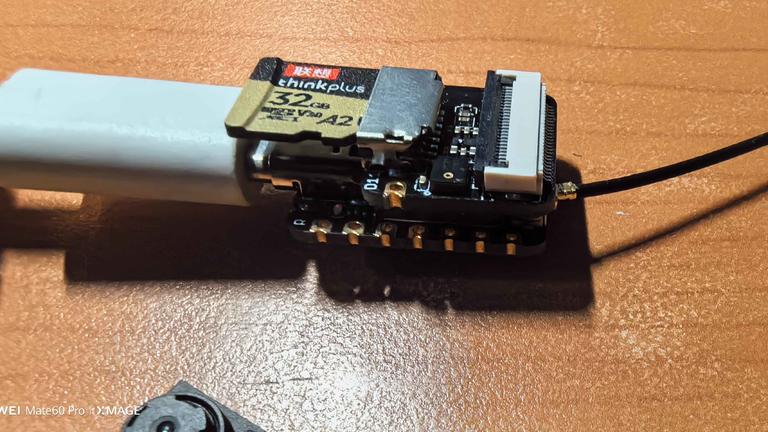
An on-device keyword spotting system for detecting pet vocalizations, built on the Seeed XIAO ESP32S3 Sense board. The system leverages TinyML techniques to perform real-time audio inference on a resource-constrained microcontroller, recognizing specific pet sounds (e.g., barking, meowing) without cloud connectivity. The project explores KWS (Keyword Spotting) model training, on-device deployment, and edge computing for smart home applications — enabling responsive, privacy-preserving pet monitoring at the edge.
Hackster.io |
电子森林 |
KWS 教程参考 |
摘要
一套基于 Seeed XIAO ESP32S3 Sense 开发板的端侧关键词识别(KWS)系统, 用于检测宠物发出的声音(如犬吠、猫叫等)。系统利用 TinyML 技术在资源受限的 微控制器上实现实时音频推理,无需云端连接即可完成声音识别。 项目探索了 KWS 模型训练、端侧部署以及面向智能家居的边缘计算应用, 实现响应迅速且保护隐私的边缘端宠物监控。 |
|
abstract
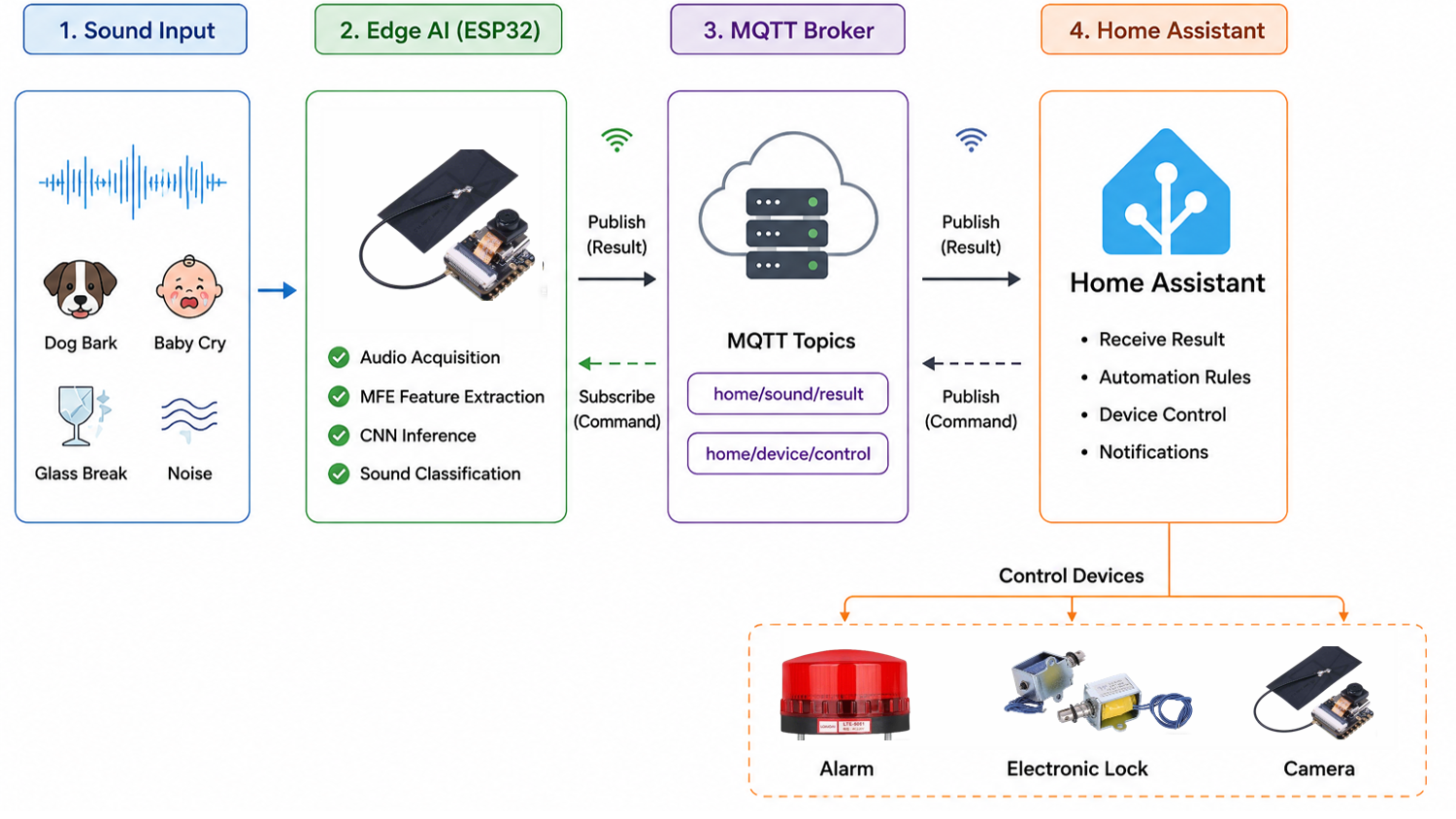
With the rapid development of Internet of Things applications, home security systems are increasingly required to provide low latency, reliable warning, low power consumption, and better privacy protection. Traditional cloud-centered security architectures usually upload raw sensor data to remote servers, which may introduce network delay, bandwidth pressure, and potential privacy risks. To address these problems, this paper proposes and implements a lightweight edge-computing-based smart home security system. The system uses an ESP32-S3 edge node to collect sound signals and perform local inference. Mel Frequency Energy (MFE) features are extracted from one-second audio segments and fed into a lightweight one-dimensional convolutional neural network. Instead of transmitting raw audio, the edge node publishes only classification results and confidence values to a Message Queuing Telemetry Transport (MQTT) broker. Home Assistant then subscribes to the corresponding topics and executes hierarchical automation rules, including local alarm activation, smart lock control, and mobile notification. Experimental results show that the proposed MFE + Conv1D model achieves 97.1% validation accuracy. In a simulated home environment, the average recognition accuracy reaches 92.5%, the single-sample inference latency is less than 20 ms, and the emergency alarm accuracy reaches 96% under compound dog-bark and glass-breaking scenarios. The results demonstrate that the proposed system can provide a low-cost, low-latency, and privacy-aware solution for practical smart home security.
摘要
随着物联网应用的快速发展,家庭安防系统对低延迟、可靠告警、低功耗和 隐私保护提出了更高要求。传统以云为中心的安全架构通常将原始传感器数据 上传至远程服务器,可能引入网络延迟、带宽压力和隐私风险。针对这些问题, 本文提出并实现了一种基于边缘计算的轻量级智能家居安防系统。系统采用 ESP32-S3 边缘节点采集声音信号并进行本地推理,从一秒钟音频片段中提取 梅尔频率能量(MFE)特征,输入轻量级一维卷积神经网络。边缘节点仅将分类 结果和置信度发布至 MQTT 消息代理,Home Assistant 订阅相应主题并执行分级 自动化规则,包括本地报警、智能锁控制和手机通知。实验结果表明,所提出的 MFE + Conv1D 模型验证准确率达 97.1%,在模拟家居环境中平均识别准确率 为 92.5%,单样本推理延迟小于 20 ms,复合狗吠与玻璃破碎场景下的紧急报警 准确率达 96%。结果表明该系统可为实际智能家居安防提供低成本、低延迟且 保护隐私的解决方案。 |
|
|
|
|
|
|
|
Website template inspired by Tairan He. Last updated: June 2026. 网站模板参考自 Tairan He。 最后更新:2026年6月。 |